Wednesday, October 29, 2008

Finally, the fall of sub-prime market -1

As I discussed in previous blogs , due to the lowering of the interest rates and easing of loan formalities banks had disbursed immense loans to non-credit worthy folks. This extra special effort to increase the credit circle had enhanced their probability of taking a fall exponentially.

After 2004, fed started raising the interest rates again slowly. this was a measure to control inflation and to reduce the trade deficit. Trade deficit refers to the difference in the earning via exports and payments via imports. So if a country is exporting more than it imports then the trade deficit is negative and viceversa. Common sense tells us that it makes more sense to have a negative trade deficit as it allows a country to earn.

But if the interest rates are low, then it makes sense for people to borrow and buy goods. And if by chance the currency is strong ie. people can buy more for $1 then it makes even more sense to buy on credit. This in-turn puts pressure on economy.

With china refusing to float its currency and US interest rates at all time low in 2003-4, the consumption was at a ll time high and the national saving rate for US came down to 1%. We will speak more about the US saving rate later on but suffice it will to say that US citizens were spending more than they could afford. And to counter this situation, Fed was raising rates.
Whew.

Tuesday, October 28, 2008

Happy Diwali to all

Wish you all a happy and prosperous Diwali.
May all your dreams come true this festive season.

Sunday, October 26, 2008

Repo rate - housing loan rate relation (interest rate)

The recent market crash has left people high and dry. Banks have been facing liquidity crisis. Liquidity crisis is a phenomenon where banks or individuals do not have enough cash to honor their debt obligations. To counter this situation RBI has opted for Repo rate cut by 1% to induce and inject liquidity into the system.

Repo rate is the rate at which banks and financial institutions can borrow from RBI for short durations. The duration can vary between overnight borrowing to 1 week. The lower the repo rate, the cheaper is the fund availability to the banks. Reduction of repo rate allows banks to borrow cash from RBI at a lower rate to meet their obligations.

Whether this rate cut leads to reduction in housing loan rates or PLR remains to be seen. Usually, repo rate cuts translate into reduction of interest rates and housing loan rates. This is simply a result of cheaper availability of funds to banks. But since the repo rate ensures short duration funds to the banks whereas the loans are long term, banks need confidence measures from RBI that the repo rate will remian same for some time. This then allows banks to work out their short term borrowing against long term lending.

Thursday, October 23, 2008

CDO's and CDS's - The keywords

It is interesting that 2 keywords which form the center of all the economic meltdown, remain a mystery to anyone not involved in investment banking. In this post, I will try to explain not only the meaning but also the functioning of these keywords in relation to the sub-prime mess.

CDO and CDS are the two instruments or vehicles created by investment banks to lower the risks involved in sub-prime lending. As the markets started to crack during the dotcom bust in 2000-01, people lost trust in the markets and started hoarding the money. As a result,Liquidity (the amount of money available in markets) started drying up which further pushed the markets down. if the markets are in bad condition then the fund flows to safe deposits with banks and government securities as they offer lower but safer returns. But as people start to save, they reduce their consumption putting pressure on industries and economy.


Reproduced with the permission of Mortgage-X.com

To counter this phenomenon, US government started reducing deposit rates and interest rates to lure people to borrow and consume more. Over a period of 3 years interest rates were reduced by 50%. This action boosted people to invest in homes and borrow heavily. The government also lowered the discretion for loan borrowing and allowed loans to be given without thorough paper work and checks. Here we take a break to understand the concept of credit score.

Credit Score -

Usually the credit worthiness of an individual is measured on a credit score. This credit score evolves out of payment history of the individual. 800 is the perfect score and 620 is the cutoff score for the loans which means anyone with a scoreless than 620 should not be granted loan.

And we are back -

To make maximum profits banks started lending at breakneck speed and soon were offering loans even to jobless people but at a slightly higher interest rate (usually +2%) to counter for their unemployment. These loans came to be known as Sub-prime loans and were offered to people with credit score of less than 620. On the hindsight, one can argue that sub-prime loans were much more riskier than Prime loans but at that time it seemed to be in vogue and the best idea ever devised.

Now, the banks and institutions making sub-prime loans were commercial banks and the mortgage institutions and investment banks were not in the picture. But the greedy investment banks can not stay away from lucrative opportunity for long. But they can not directly lend to the individuals so they had to create an instrument to get involved.

Voila, I-banks created CDO's (Collaterized debt obligation). They argued that if bank gives a sub-prime loan then there is small chance that the individual will default. But if bank gives sub-prime loans to 10,000 individuals then the risk of default reduces as not all individuals will default at the same time. This model reduces the chances of default and makes the loans safer. Using this model, I-banks bought mortgages and created pools of individual mortgages into CDO's and started selling pieces of these CDO's to financial institutions. These institutions received the installment payments from loan bearers in return and the rate of return was higher than the market. Since the CDO's were covered by properties and default chances were very small, these were granted AAA rating by Moody's and other rating organizations. AAA is the best rating for any bond in US.

So, the I-banks took the individual sub-prime loans off the balance sheet of mortgage companies and commercial lenders but again sold pieces of CDO's back to these banks. Uptill this point, I-banks were minting money without actually getting their hands dirty. They were buying a product from market, modifying it and selling it back to the market. They also retained some of these CDO's with them for investment.

But a wise ass went a step further. He thought that since their is a infinitesimal chance of CDO defaulting, what if we can start selling insurance against these CDO defaults. Since CDO's will noit default all the premium we earn will be profit. The idea seemed amazing and I-banks got busy creating a new instrument for this purpose. They came out with CDS (Credit default swap). This is an instrument that gurantees the buyer insurance against CDO default. So, I-banks started selling CDO's to the financial organizations and then also started insuring these CDO's.


Sub-Prime on the lighter side


Interesting Slide show on how subprime mess came around


Subprime
View SlideShare presentation or Upload your own.
SlideShare Link

Wednesday, October 22, 2008

On the top of the world


Year 2000-01
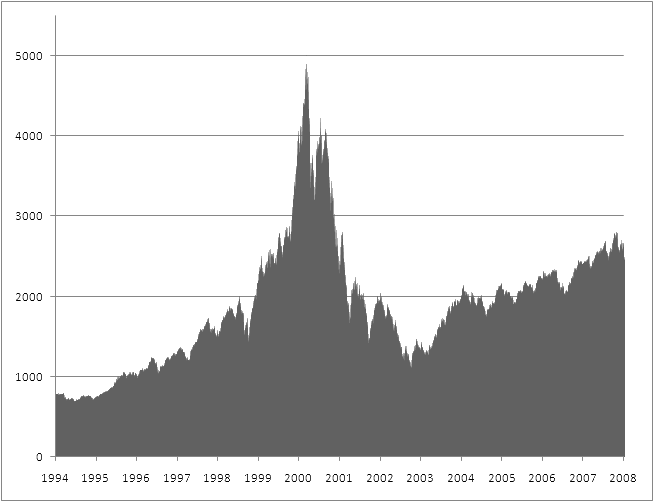
The US stock index, NASDAQ peaked on March 10, 2000 to 5048 points, more than double its value just a year before. Few reasons contributing to the severe market fall after March 10 were -
  1. A multimillion dollar sell order was placed on several large internet companies like IBM, Dell, Cisco on March 13 (Monday). People suggest that it was a coincidence but one can never be sure. The markets tanked 4% on opening to 4879, the largest pre-market fall in an year.
  2. The second major reason could be sited as the declaration by the Federal court that Microsoft was indeed a monopoly. This shook the confidence people had in software companies.
  3. The third reason was reduced expenditure by US companies as the Y2K issue got resolved for most of the companies by the start of year 2000. This caused a drop in revenue for a lot of software companies.
All these reasons combined together to bring around 9% drop in NASDAQ in 6 days and NASDAQ closed at 4580 on March 15. By 2001, the markets fell in full flow and several companies burnt their venture capital never actually recording any profit. This crash caused individual investors to flee the markets with their investments, looking for a better investment opprtunity.

Tuesday, October 21, 2008

Begining of the end

Year 1998-99
US stock market was thriving on the dotcom boom. Everyday new internet companies were being floated as it was the "in thing". The markets loved these companies and their stock soared the day they listed on the bourses (Stock exchange) and within a few days the stock prices defied the Mt. Everest. There was no particular asset backing the mind boggling stock price and the business was based on immense growth and acquiring customers at the expense of making losses. This new business trend was christened the new economic order of the new millennium.

Traditionally, a stock rises in value as the company experiences growth and increases its cashflow and assets. But in internet domain, company had no assets and were not making profit but their stocks were being sold like hot cake as they expected to mint money later on by monetizing their customer base. However, no one had the faintest notion about how that monetizing will happen and how the internet companies will make the promised fortunes.

Companies like Enron took benefit of this situation and created new business domains. Enron started trading energy on exchanges and introduced a new concept of accounting, "Mark to Market". I will discuss the various accounting practices in a separate post but suffice it will to say that Enron planned to count its chicken even before the eggs were laid. The basic idea of this new accounting practice was to project future revenues and record them immediately. This promised immense growth to Enron even before their projects like Dabhol in India which was never even completed. Enron also created artificial demand by curbing supply of electricity in California and combined with their auditing partner, Arthur Anderson, which authorised all their practices, they kept on playing with the markets.

Humble Beginings

Everyday, as I watch the money markets tumble and scared investors discussing the future of their investments, I think. I think about the story preceding this mess, the unforeseen tragedy of events and russian roulette of greed. I think about the long term effects of this crisis and whether it will affect the Indian growth story. I also think about the man on street who invested in share markets and who now grapples with bits and pieces of news and yearns to make the head and tail of the situation.

TV programs talk about the devaluation of Rupee against the Dollar, the price correction in commodity markets, speculation based oil price volatility, CRR cuts and repo rate cuts but none of this explains the true situation to a common man. Nobody explains how and why jobs are being slashed across the industry and why in-spite of all efforts everyday prices for household goods are rising. Common man deserves to understand the effects of so called "policy changes" on his daily life.

Through this blog, I try to explain the economic turmoil and the day to day changes in simple language. Mind you, I am not an expert. But my interest in economics and the fact that I was pursuing my MBA when the US housing bubble burst pushed me to delve deeper. The topic intrigued me and I worked on a paper on "Sub-prime lending", thereby gathering information and understanding of the underlying issues.